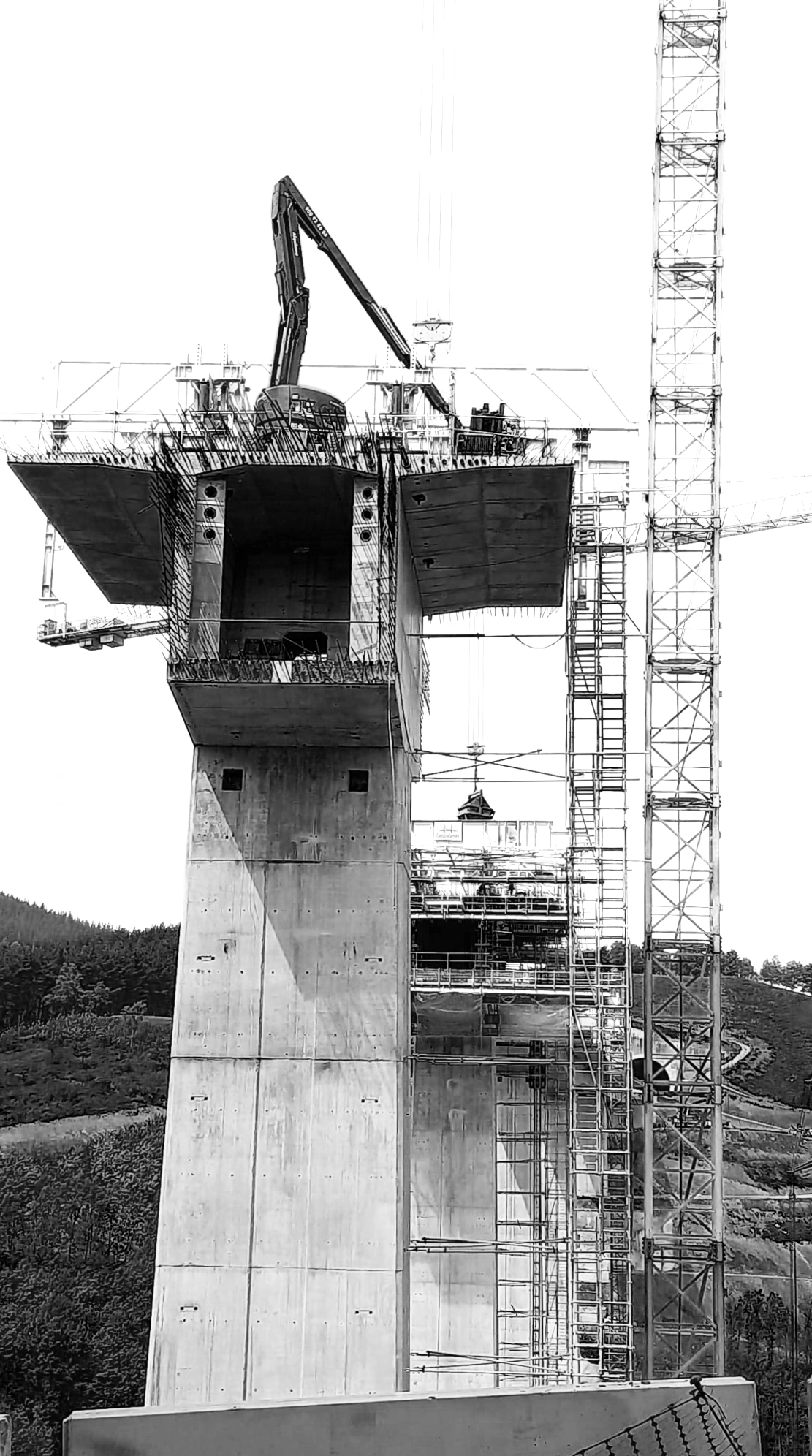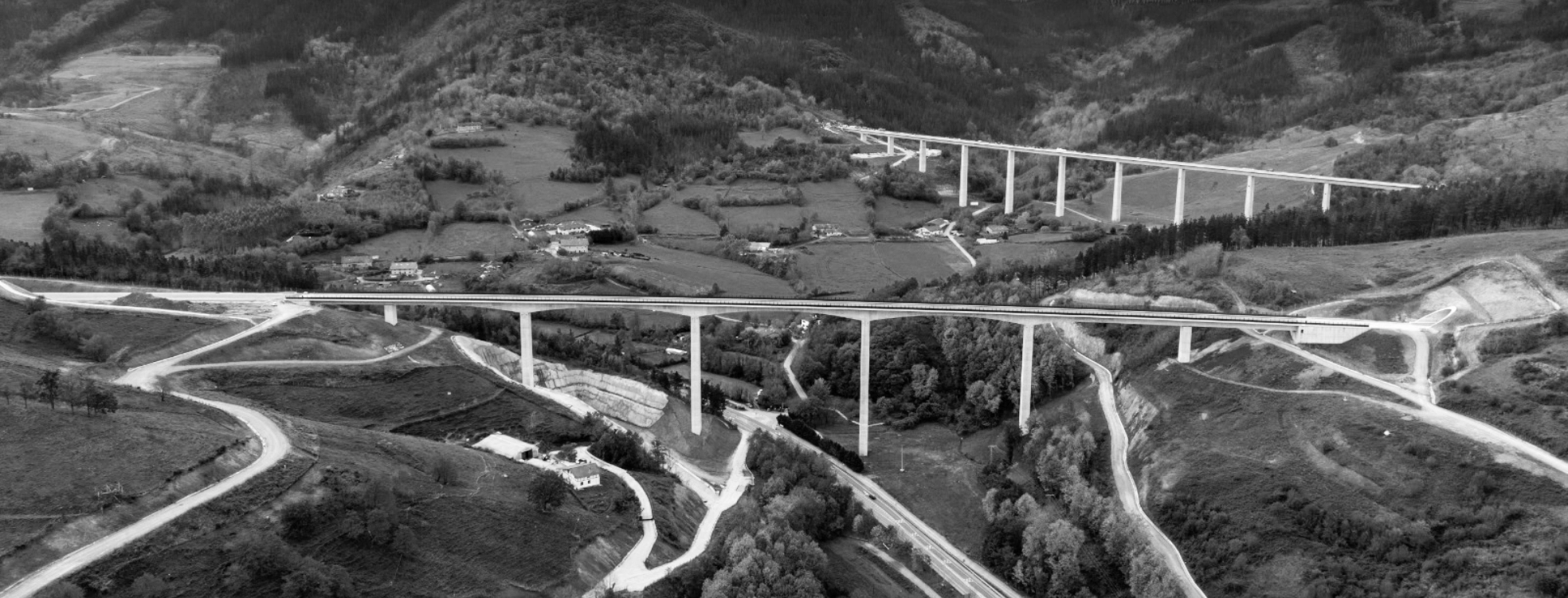
The Zumelegui viaduct is located on the section Elorrio – Elorrio, which is part of the HSL Vitoria –Bilbao – San Sebastián. It is a 481-meter-long balanced cantilever bridge, divided in 7 spans, and with a maximum length of 85 meters. It allows passage over the current N-636 road, considering its future extension as well, and is located in a natural setting of great beauty.
The Zumelegui Viaduct is a 481-meter-long structure, divided into 7 spans with a span arrangement of 51+75+80+85+85+67+38 meters, belonging to the Elorrio-Elorrio section of the Vitoria-Bilbao-San Sebastián High-Speed Line. It is located in a setting of great beauty, in a valley surrounded by mountains.
The deck consists of a post-tensioned concrete box girder rigidly connected to the four central piers, from which construction proceeds using the balanced cantilever method. The first and last spans are cast on falsework and are supported via Pot bearings at the piers and abutments.
The box girder features a variable depth, starting at 4.25 meters in span 1. From span 2 onwards, it increases to reach maximum values over the piers: 6.5 meters over piers 2 and 5, and 7.0 meters over piers 3 and 4; with minimum values of 3.25 meters at the mid-span of the central spans and in the final span.
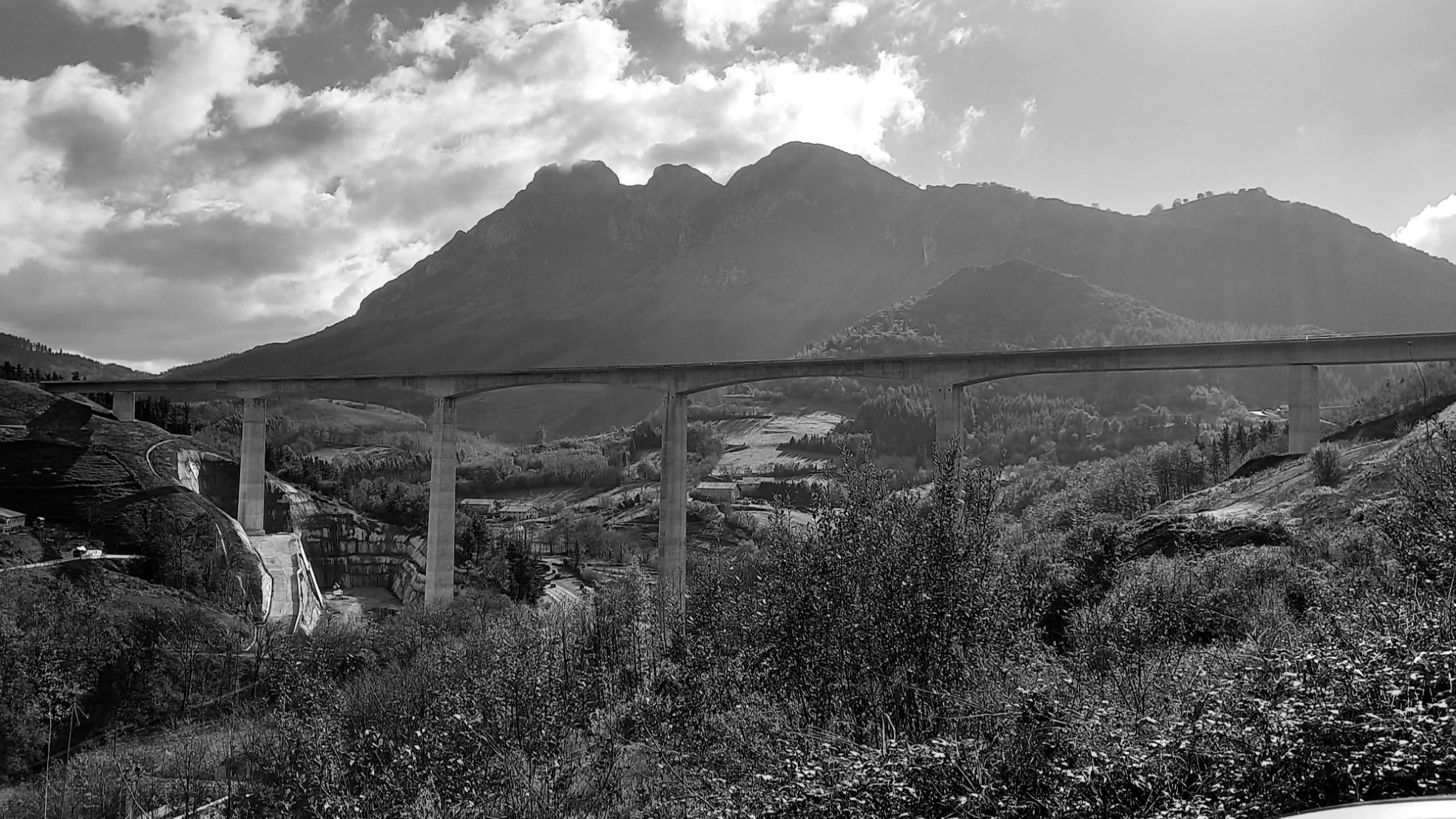
The pier design sought a balance between minimum stiffness, to ensure safety during construction, and the maximum possible slenderness to minimize internal forces due to imposed deformations under service conditions.
To resist horizontal loads at Abutment 2, Shock Transmission Units (STUs) with maximum force limitation have been installed. Consequently, the viaduct's behavior regarding imposed deformations is governed by the rigid connection between the deck and the four central piers, as these devices provide no restraint against slow-moving actions. However, under fast-acting loads, the STUs are designed to resist forces with minimal displacement in collaboration with the central pier.